

Reading Time: 6 minutes
What comes to mind when you hear the phrase ‘second home’?
I’m from a town called Hicksville, a pretty unfortunate name for a hometown, and truthfully, I didn’t even realize it was funny until I left the country for the first time. It’s only about 40 minutes outside of New York City, and it was a lovely place to grow up, but I will say—the concept of owning a ‘second home’ to me, my friends, and the people I was surrounded by, was dismissed as something only for “rich people”. It was something that was out of reach for us, that we couldn’t have. More than anything, I think the way we’d respond to hearing someone talk about their family’s beach house or lake house was:
Must be nice.
Must be nice to have that kind of money to have a second home.
I was such a culprit of using that phrase. I used to say it a lot. But as I’ve gotten older, it’s a phrase I’ve really come to despise. Because when I shrugged something off as must be nice, I was essentially telling myself that this was something I couldn’t have. Which meant I never stopped to ask the one question that could have changed everything: How did you do it?
Or more importantly, how could I?
You, dear reader, have not made the same mistake as I. You’ve subscribed to this newsletter because you saw something that intrigued you. Something that made you wonder if there was another way. And I’m excited to tell you, there is!
Maybe you live in an expensive city and owning a home, any home, feels like a pipe dream. Maybe you’re looking to build wealth in a way that’s more exciting than watching a stock ticker rise and fall. Or maybe, like me, you just want to own a vacation home—a place to escape to with family and friends, somewhere to create unforgettable memories—but you aren’t sure how you could possibly afford it.
Either way, you saw something that piqued your interest, and rather than brushing it off with a must be nice you said: Tell me how. And that’s exactly what I’m here to do.
Once I started to get curious, I was then able to get creative. I was able to find a way that even I, an average person from an average town called Hicksville, could afford a second home. And if it’s something you’re interested in, I’m here to show you how YOU can do it too.
Redefining the American dream
For so long, the ‘American Dream’ has been defined as owning your own home. And there’s a ton of merit to that desire. Nothing is more important than safety, security and family, and owning your home feels like you're living life on your terms. Throughout my adult life, I have always lived in big cities (NYC and London), renting 7 different apartments over the course of 16 years, including my current home. Twice I was forced to move out, not by choice of my own—one landlord was selling, one was tired of dealing with a cranky neighbor. I, too, prefer the idea of a home that no one can take away from me—well, aside from maybe the bank.
But a recent Bankrate study showed that renting is now more affordable than buying in all 50 of the largest U.S. metros. My current New York City apartment is proof of that. Let’s take a look:
A real life NYC example
We currently pay $3,995 a month for a 2 bed, 2 bath duplex, 1600 sq. ft. apartment with an oversized basement that doubles as a bedroom and a playroom (and an office… and a workout space… and a laundry room… and a podcast studio—this is NYC after all, the king of dual purpose spaces!). Whether that feels expensive or cheap, let’s look at what a comparable space would sell for.
Zillow currently shows the lowest price for a similar footprint in my neighborhood as $925,000. Truthfully, that price is if you found a screamin’ deal and didn’t mind doing a LOT of renovating, but let’s go with it to see how it compares to my rent:
To put 20% down, I would need $185,000. If I had great credit and my lender was open to a smaller downpayment (as little as 5% - 10%), that amount could be reduced to between $46,250 and $92,500.
For a purchase price of $925,000, Bank of America calculates closing costs to be approximately $36,746.
Now for the monthly payment. With 20% down, we’re looking at $5,758 per month—that's $1,763 more than my rent, or $21,156 more annually.
When you drop the down payment to 5%, that monthly payment increases to $7,252! That would be $3,297 a month more than what I’m paying to rent, or $39,084 per year!
Plus, as a homeowner, you have the joy and financial burden of household repairs. One commonly cited rule is to set aside 1% of your home's purchase price annually for maintenance and repairs—in this case: $9,250. For renters, that cost is borne by the landlord.
So let’s look at how the numbers break down:
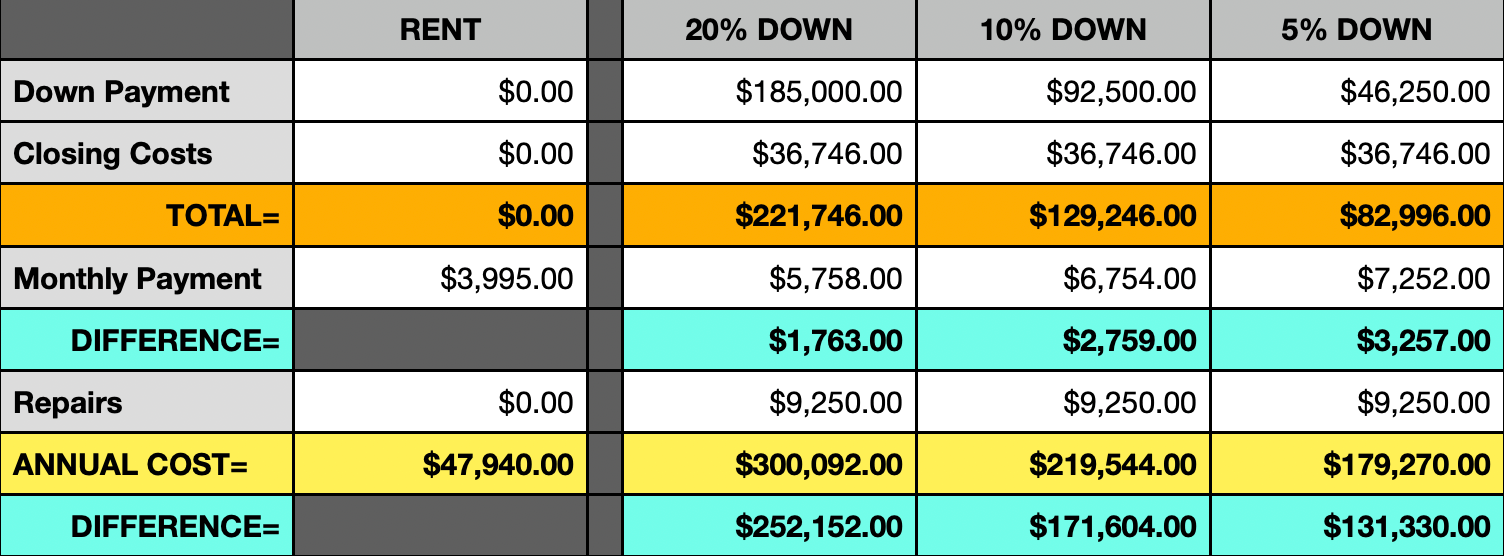
Wow. In that first year, between laying out the down payment and covering the closing costs, you could be spending as much as a quarter of a million dollars MORE than just paying rent.
But isn’t renting just “throwing away” money?
Ah, the age old argument. I get it. Part of that astronomical mortgage payment every month is going towards paying down your principal, actively building you equity in the asset you’re living in. And that’s wonderful! But with the numbers above, most people—including myself—are left with two options:
Downsize to something more affordable
Move someplace less expensive
Honestly, those options suck. For myself, with two children, downsizing much more wouldn’t really be feasible. (See above slash-slash list of all the dual-purposes my space is already serving.) Not to mention, there are a million different reasons why people can’t move—or don’t want to.
And this is where the idea of buying your 'second home' first comes in…
Another Way
My husband and I were moving back to New York after spending six years living abroad in London. Unfortunately, my mother is very sick, and we needed to come home to be closer to her. Returning to NYC, now as parents to a toddler, left us with a lot of questions: Would we still like living here? Is this a place we’d want to stay long-term? And even if the answer to both was yes, the reality was, we couldn’t afford to buy here. We had saved some money for a down payment, but nowhere near the $130k - $250k range demonstrated above. For us, the math wasn’t mathing, so we decided to rent an apartment, giving us flexibility to pivot in the future, and bought our ‘second home’ near Lake George in upstate New York.
Nicknamed the “Queen of American Lakes,” Lake George is a sentimental place to us. Early in our relationship, we camped there every summer with our dog, grilling three meals a day, sleeping in a tent, and enjoying the simple pleasures of the outdoors. But at some point during each trip, inevitably missing the indulgence of a hot shower and electricity, I always thought, wouldn’t it be nice to own a house here someday?
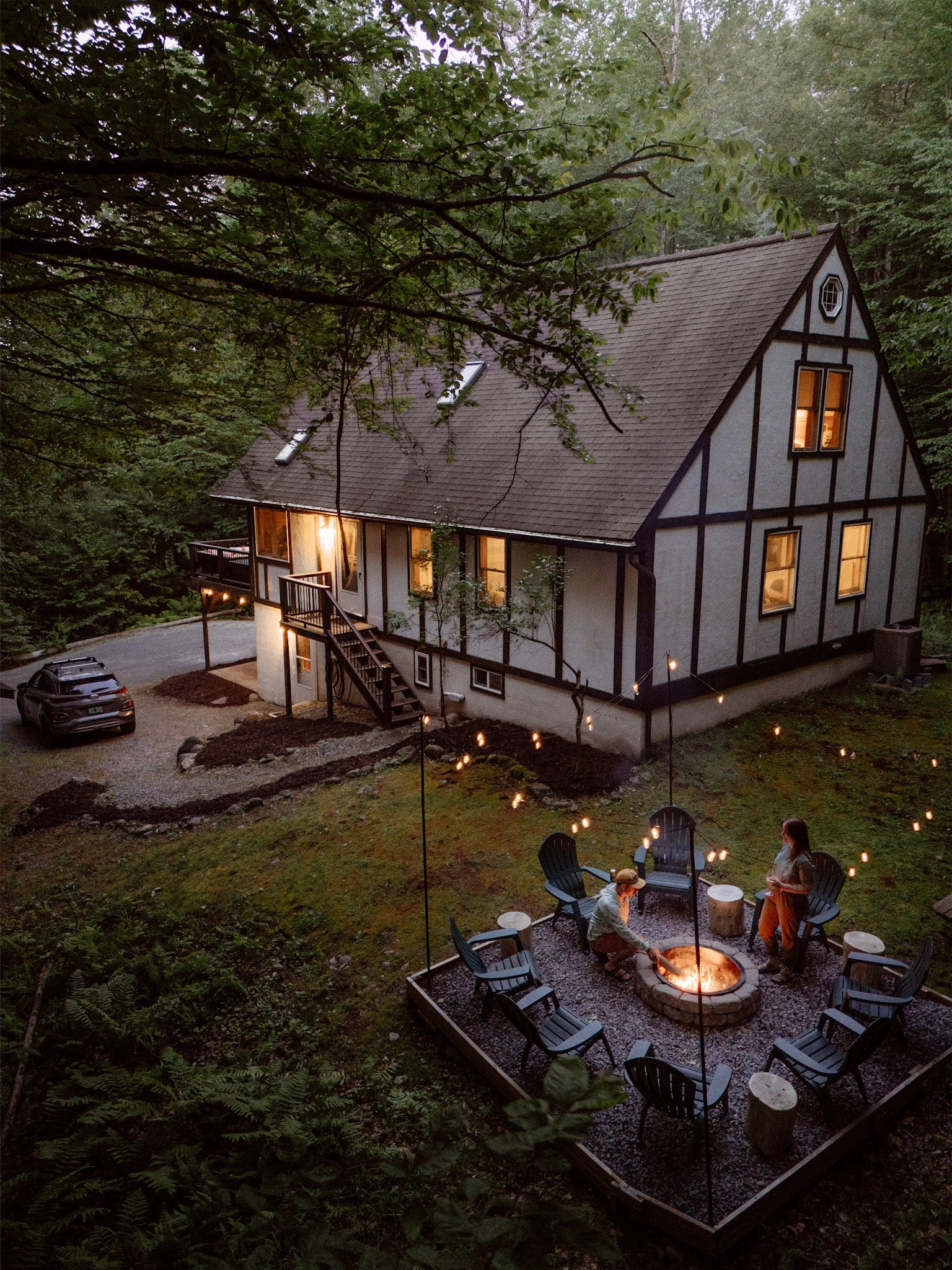
We found a property (pictured above) in Warren County, where the median sold price was in the $300k range—a stark contrast to Manhattan’s median of $1.3 million! I planned to list the property on Airbnb and Vrbo, hoping that when we weren’t there, rental income could help offset some of my costs. What happened next shocked me.
Not only did we cover all of our annual costs—we actually turned a profit!
It felt like a lightbulb moment. Friends and family thought we were crazy—you’re going to buy a place but not live in it!? was a common refrain we heard. But the numbers didn’t lie. I felt like I had tripped into the best investment strategy, one that helped me build wealth for the future, without sacrificing enjoyment today.
I see it as similar to a retirement account… that is, if your 401(k) came with a fire pit and a lake view!
Owning a ‘second home’ offers the long-term financial upside of traditional investments—growing in value, building equity and even providing income—but with two major differences:
My mortgage is paid by short-term renters, not by my own contributions;
And when it’s not booked, I get to enjoy my vacation home now, not someday in the future. It’s a place where I can escape the chaos of city life and reconnect with loved ones. What 401(k) can do that?
Next Week...
Location is everything, but it can also be the hardest decision to make. In next week's newsletter, we'll cover what to consider when selecting where you want your dream vacation home to be. Included will be my favorite Sticky Note Exercise to help you move from abstract ideas to a concrete, personalized vision of your perfect getaway.

Like what you read today? Have a question? Just want to say hi? I’d love to hear from you. Email me at Hello@BuyYourSecondHomeFirst.com. I personally read and respond to every single note.
Or forward this newsletter on to a friend you think would enjoy it!
*The content shared on Second Home First is for educational and informational purposes only. Please consult a licensed financial advisor before making any investment or financial decisions.
The camping backstory is the part I'd underline. You already knew you loved Lake George before you bought, which is the step most people skip. One tension I'd love to read more about: the weeks you most want to be there yourself are usually the same weeks guests want most. How do you decide which summer weeks you keep for your family and which you open up? That trade-off seems to shape how a second home actually feels to own.
This was fantastic and exactly what I needed to read. Well done you!